
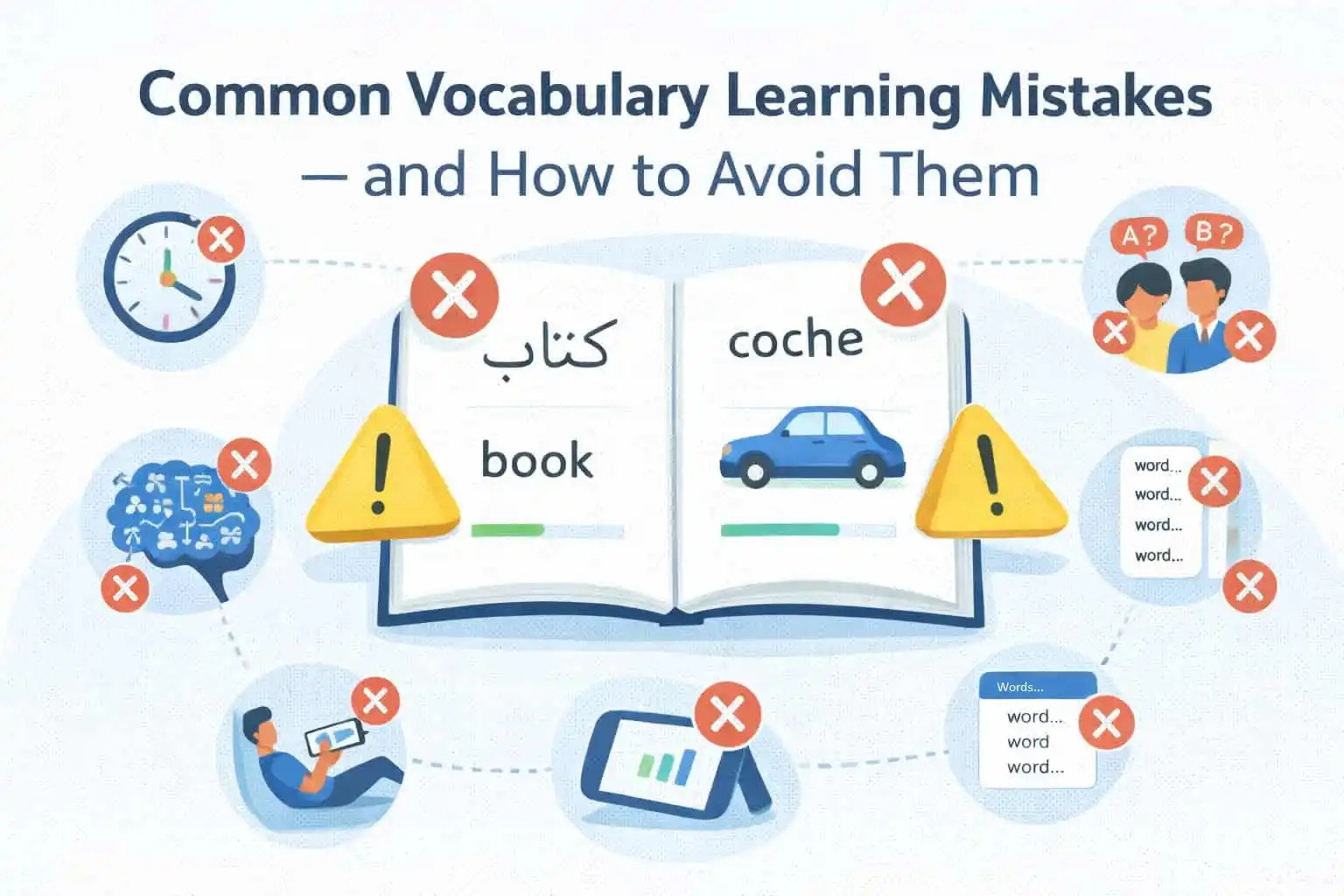
Common Vocabulary Learning Mistakes — and How to Avoid Them
Why Vocabulary Is Harder Than It Looks
Many language learners feel frustrated when studying vocabulary. They learn new words today, only to forget them a few days later. This isn’t a lack of ability — it’s usually the result of common learning mistakes.
Understanding these mistakes is the first step toward fixing them.
Mistake 1: Memorizing Without Reviewing
Learning a word once is not enough. Without review, the brain quickly lets go of new information. This is one of the most common reasons vocabulary disappears.
How to avoid it: Use spaced repetition. Review words at increasing intervals, especially right before you’re likely to forget them.
Mistake 2: Studying Too Many Words at Once
Trying to memorize dozens of words in one session overloads your memory. The brain performs better with smaller, focused sets.
How to avoid it: Limit each session to a manageable number of words and focus on quality, not quantity.
Mistake 3: Passive Learning Only
Reading word lists or watching videos feels productive, but passive exposure alone doesn’t build strong memory.
How to avoid it: Practice active recall. Test yourself, answer questions, and force your brain to retrieve the word.
Mistake 4: Ignoring Pronunciation
Many learners focus only on spelling or translation and skip pronunciation. This weakens listening and speaking skills.
How to avoid it: Always connect words with sound. Listen to pronunciation and repeat it aloud whenever possible.
Mistake 5: Learning Words Without Context
Memorizing isolated words makes them harder to remember and use correctly.
How to avoid it: Learn words with example sentences, common usage, or real situations.
Mistake 6: Inconsistent Study Habits
Studying intensely one day and then stopping for a week breaks the learning cycle.
How to avoid it: Study a little every day. Even 10 minutes of daily practice is more effective than long, irregular sessions.
How Quiz4Learn Helps You Avoid These Mistakes
Quiz4Learn is designed to solve these problems automatically:
- Spaced repetition ensures timely reviews
- Short quizzes prevent overload
- Active recall strengthens memory
- Audio support improves pronunciation
- Progress tracking keeps learning consistent
Build Smarter Vocabulary Habits
Forgetting words is not a failure — it’s a signal that your learning system needs improvement. By avoiding these common mistakes and using smarter tools, you can make vocabulary stick for the long term.